Posted by Andy Bartocci on Tue, Jul 13, 2010 @ 01:57 PM
I gave recent presentations at the International Biomass Conference in Minneapolis, MN and the International Thermal
Treatment (IT3) Conference in San Francisco, CA on wet scrubbers for gasification. Below is the paper abstract. A free download of the paper and presentation is available by clicking the links below. The paper discusses two common tar management approaches regarding syngas cleaning:
- Thermal Tar Destruction Systems
- Tar Removal Systems
ABSTRACT
Concern for global climate change coupled with high oil prices has generated new interest in renewable energy sources. Many innovative companies are working to commercialize these sources using gasification to convert waste to energy and fuels. Gasification is a thermal conversion process which produces synthetic gas (syngas). With proper cleaning, syngas can be used to fuel an internal combustion engine (ICE) to drive a generator, and produce electricity. Waste heat is recovered from the system to improve the overall plant efficiency.
During gasification, various pollutants may be produced depending on the type of gasification process and the make-up of the waste feedstock. The feedstock can vary from biomass, municipal solid waste (MSW), to even medical or hazardous waste. The pollutants involved can include large to sub-micron particulate matter, tars, and acid gases. A key challenge to commercializing gasification is designing a syngas cleaning system that removes pollutants to a level that is tolerated by the ICE (or fuels and chemical production system) and also meets emission standards. This paper will discuss different approaches to tar removal and control strategies for the various pollutants.
Please click on the below icons to download the IT3 conference white paper and the International Biomass Conference presentation.


Posted by Andy Bartocci on Tue, Jul 13, 2010 @ 01:57 PM
I gave recent presentations at the International Thermal
Treatment (IT3) Conference in San Francisco, CA and the AWMA Conference in Calgary, Canada. The paper is co-authored with Liran Dor, CTO of EER - Environmental Energy Resources Ltd. The paper discusses an environmentally friendly way of converting medical waste to energy using EER’s Plasma Gasification Melting (PGM) and Envitech’s wet scrubbing technology.
ABSTRACT
A plasma gasification melting (PGM) technology has been developed to transform waste into synthesis gas and products suitable for construction materials. The core of the technology was developed at the Kurchatov Institute in Russia and has been used for more than a decade for the treatment of low- and intermediate-level radioactive waste in Russia. It is applicable to municipal solid waste (MSW), municipal effluent sludge, industrial waste and medical waste.
Plans are currently underway to build a plant in the US to recycle medical waste using the PGM technology into a high calorific Syngas and a benign residue. Both output materials may be considered secondary materials since they have commercial use in other processes. Current plans include the production of steam which will be sold as a commodity to nearby industrial users.
The Syngas is fed into a Heat Recovery Steam Generator (HRSG) to produce superheated steam for use as heat or electricity generation using a steam generator. The Syngas leaving the HRSG will enter an Air Pollution control (APC) system for post process gas cleaning. The APC system will use a wet scrubber system that has successfully achieved low emission standards on other typical combustion processes. This paper will discuss how these technologies are combined to create an economically viable and environmentally friendly solution for converting medical waste into energy.
Please click on the below icon to download the AWMA and IT3 conference white paper.

Posted by Andy Bartocci on Tue, Jun 08, 2010 @ 07:59 AM
The US Department of Energy (DOE) has funded R&D in coal gasification in recent years as part of a strategy to reduce green
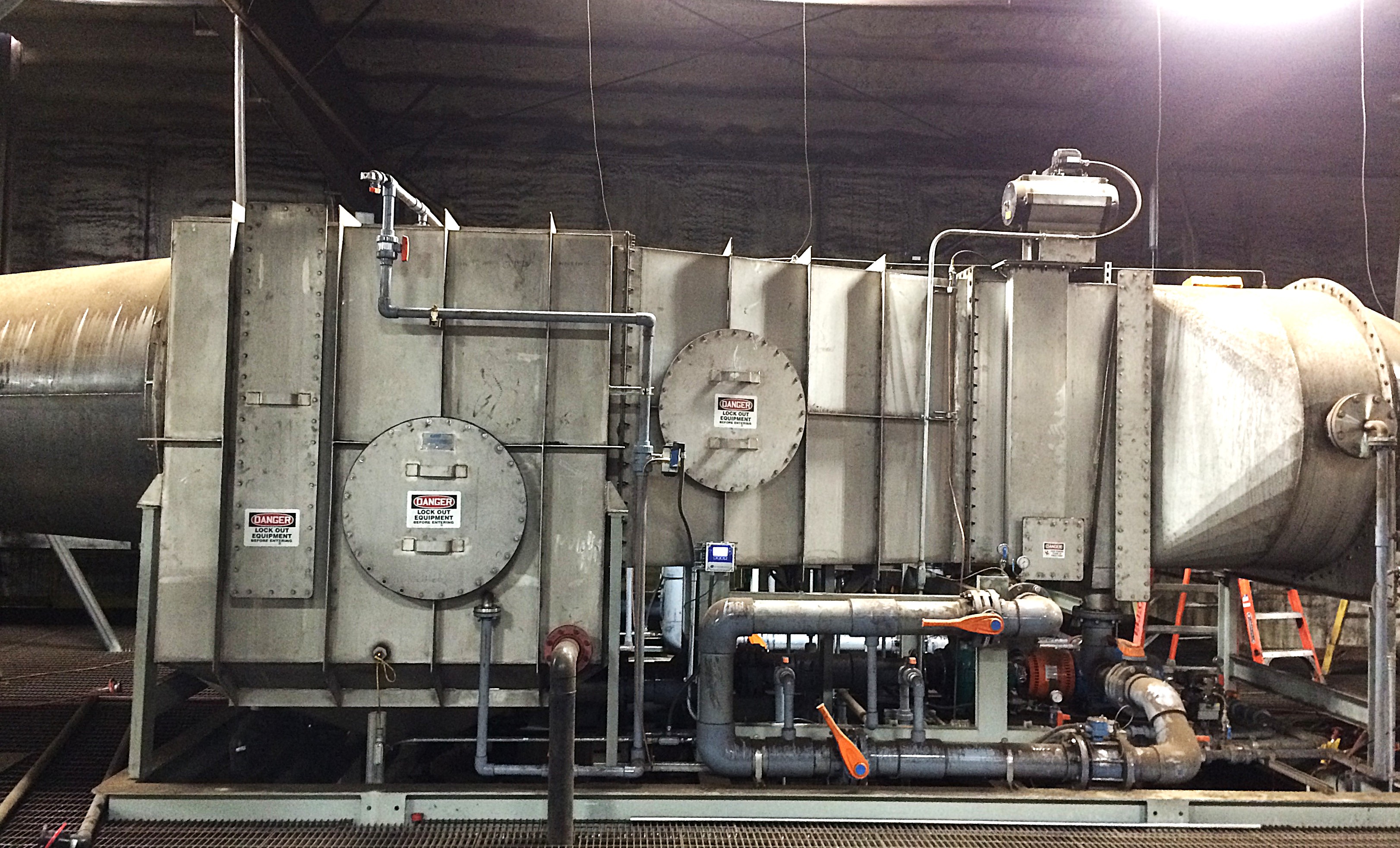
house gases. One aspect of this technology is the use of coal dryers to dry the coal before feeding it into the gasifier. This requires a coal dryer scrubber which can be comprised of a Venturi scrubber followed by a condenser tower shown in the sketch.
The exhaust gas from the dryer passes through a Venturi scrubber for particulate removal then through a condenser tower to condense water vapor in the gas stream. The gas passes through a mist eliminator at the top of the condenser tower to remove water droplets in the gas stream. Re-circulated water in the Venturi throat is collected in the sump of the condenser
tower. Gas flow rates for these processes are relatively large and can exceed 300,000 acfm. Because of the large gas flows, the condenser tower can be as large as 20 feet in diameter or larger. The Venturi scrubber (shown in the image on the left) must have a special throat design to account for the large gas flow rate. The Venturi throat design is discussed in in the previous blog post for Venturi Scrubber Throat Design for Large Gas Flow Processes.
Posted by Andy Bartocci on Mon, May 03, 2010 @ 09:36 AM
In previous blog posts, I have discussed how a key to particle collection in a Venturi scrubber is maintaining uniform water distribution across the Venturi throat to collide with particles. This presents a challenge for large volumetric gas flow rate processes. The difficulty becomes getting water across a large cross sectional area without any void spaces for particles to escape through. Often times, the solution may be to simply split the gas flow into multiple trains. However, this increases capital costs for additional ductwork and piping and
takes up more real estate. It is always desirable to minimize the equipment footprint and maintain the gas flow in one train.
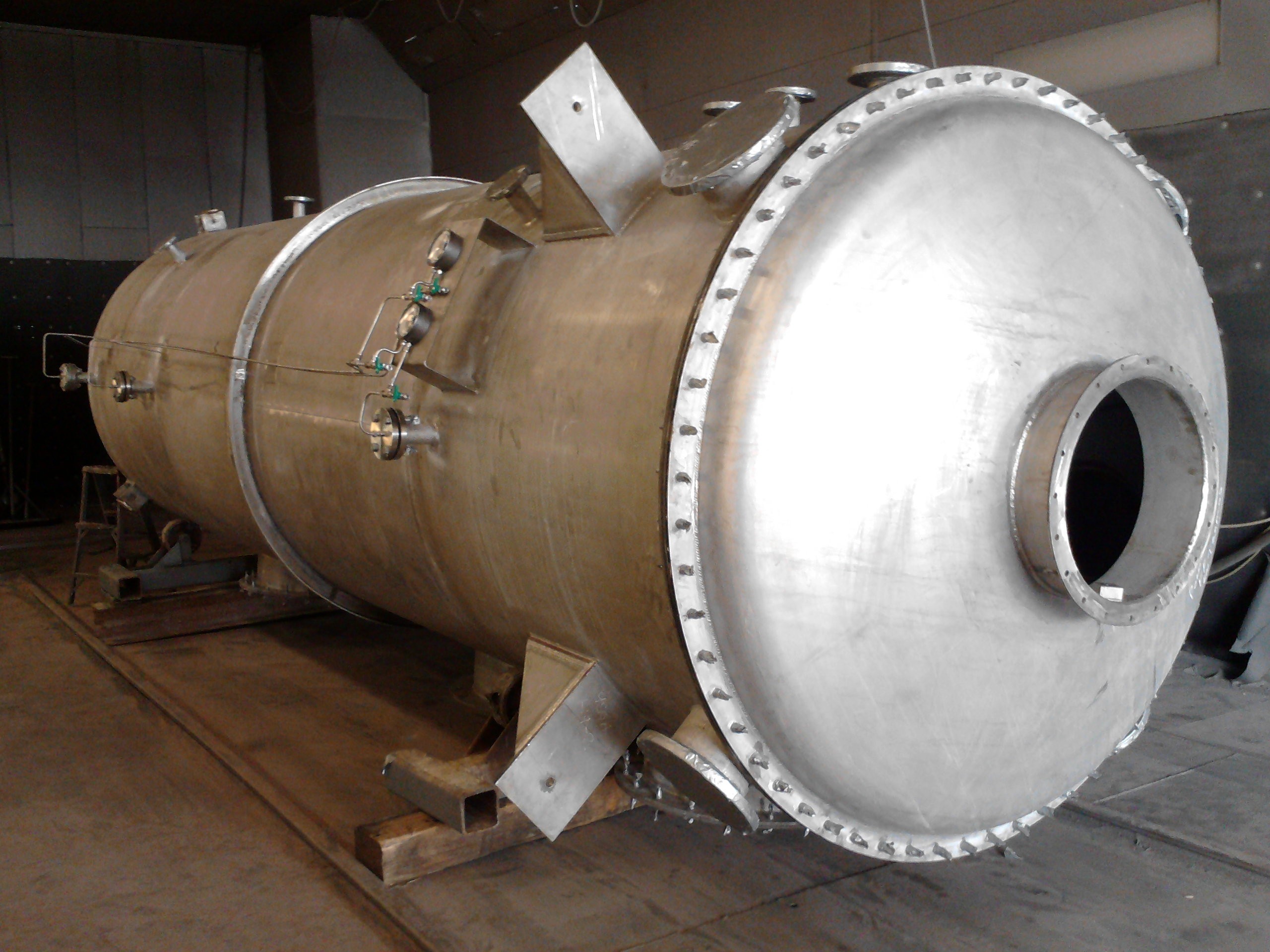
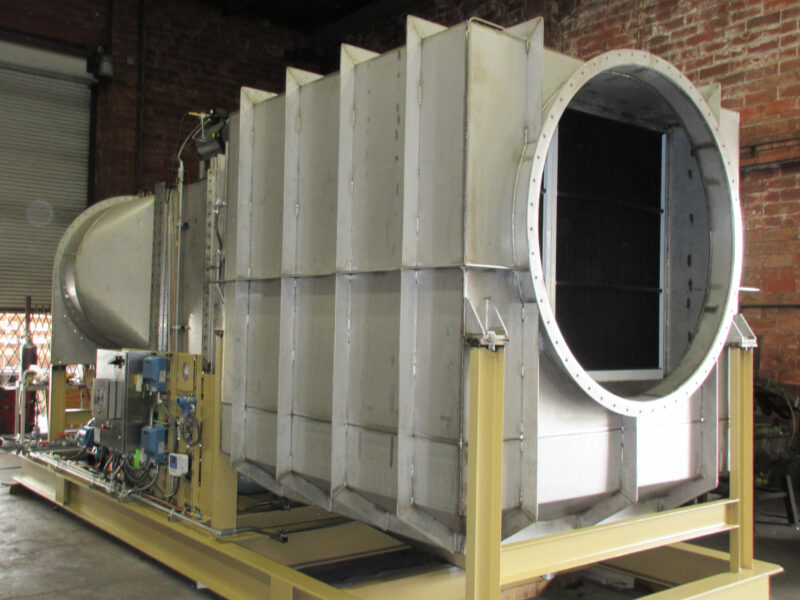
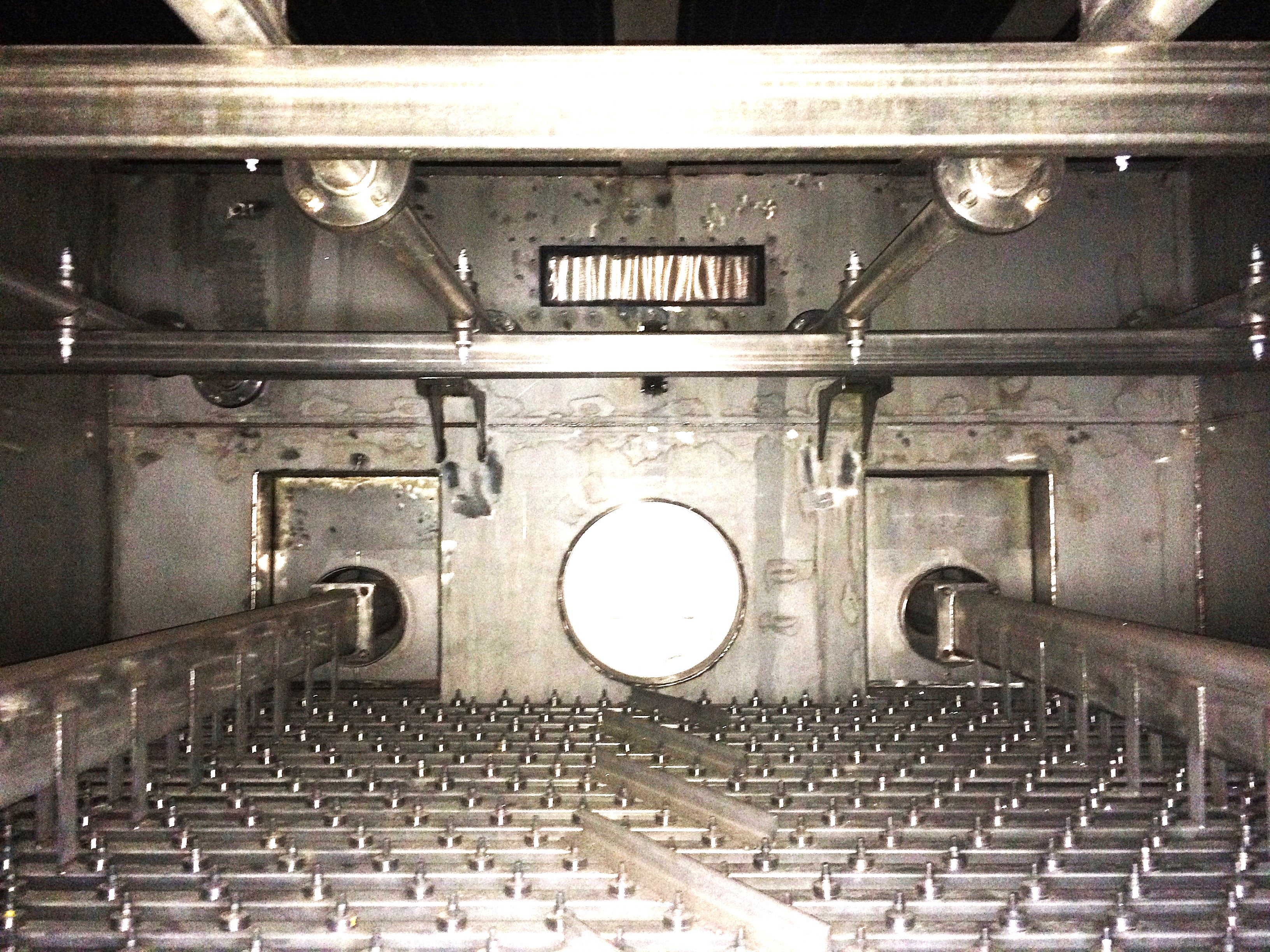
To achieve this objective, Envitech uses a proprietary Venturi throat design that has been used on large gas flow rates processes, including foundries and purified teraphthalic acid (PTA) plants. The proprietary design has an internal construction that ensures uniform water distribution throughout the Venturi throat cross sectional.
The adjacent image shows a picture of an Envitech Venturi/Quencher constructed from Hastelloy C276 used for a PTA plant with a gas flow rate of 530,000 acfm. This type of Venturi design may be used on other large gas flow rate processes like a coal dryer system for a coal gasification plant which can have a gas flow rate as large as 300,000 to 400,000 acfm.
Posted by Andy Bartocci on Tue, Aug 25, 2009 @ 03:10 PM
Back in July I wrote a blog post for gasification syngas cleaning where I discussed two general approaches, 1) thermal tar destruction, and 2) tar removal scrubbers. Both approaches require particulate removal. This blog post discusses several design considerations related to particulate control for syngas wet scrubber systems, including:
-
Performance
- Capital Cost
- Operating Cost
- Safety
These considerations will be discussed in the context of two wet scrubber approaches for particulate control:
-
- Wet Electrostatic Precipitator

Performance - The distinguishing feature between a Venturi scrubberand a wet electrostatic precipitator (WESP) is the removal efficiency for sub-micron particulate. This is shown in the above figure which compares the particle removal efficiency for a wet electrostatic precipitator (WESP) and a 50 inch water column (W.C.) pressure drop Venturi scrubber. The figure illustrates that both the WESP and Venturi are highly efficient for removing particles greater than 1 micron. The removal efficiency of a Venturi, however, begins to degrade for particles smaller than 1 micron. The Venturi performance can be enhanced by sub-cooling the gas and taking advantage of condensation effects to grow the size of the particulate. The effects of sub-cooling to improve Venturi performance is discussed in greater detail in the Envitech paper, "Wet Scrubbing Technology for controlling biomass gasification emissions" presented at the 2008 Joint Conference: International Thermal Treatment Technologies (IT3) & Hazardous Waste Combustors (HWC).
In general, WESP's are used in applications where the sub-micron particulate concentration exceeds the capability of a Venturi to meet the performance requirements. It is therefore important to understand the following:
A Venturi scrubber will give syngas cleaning performance similar to a WESP. The removal efficiency for particles greater than 1 um diameter will be equal to or greater than a WESP. For particles smaller than 1 um diameter, a Venturi scrubber will be less efficient that a WESP. However, many ICE engines will most likely tolerate these particles. Understanding the tolerance of the engine is therefore a key aspect of deciding which approach is best suited for your application.
Capital Cost - It is broadly understood that a Venturi scrubber is much lower capital cost than a wet electrostatic precipitator. Under most process conditions this cost difference can be as much as 3 to 4 times. The trade-off for a lower capital cost Venturi scrubber is higher operating cost to provide the pressure drop.
The Venturi scrubber capital cost is determined predominately by the size of the gas flow. The WESP capital cost, however, is determined by both the size of the gas flow and the desired removal efficiency. The desired removal efficiency can dramatically affect the size and cost of the system. The higher the removal efficiency, the higher the collection area, and consequently, the greater the number of collection tubes required. The cost of a WESP is approximately exponentially related to the required removal efficiency. It is important to define the performance requirements before budgeting for a WESP.
In addition to metal fabrication, there are other items contributing to the higher capital cost of a WESP, including the T/R set to provide a high voltage, electronics for a more sophisticated control system, and safety interlock system.
Operating Cost - Although a wet electrostatic precipitator is higher capital than a Venturi scrubber, part of that cost is offset by lower operating cost. The pressure drop of a WESP is in the range of a couple of inches W.C. compared to 30 to 50 inches W.C. for a Venturi scrubber. The electricity cost for the fan horse power requirements is therefore considerably lower for a WESP than for a Venturi. There are other WESP operating costs that need to be accounted for including the electricity for the T/R sets and for the heater and blowers for the insulator compartments.
Safety - The last design consideration discussed here for a syngas cleaning system is safety. A key aspect for a syngas cleaning system is that it contains a combustible gas. This carries a greater risk of fire than for other types of scrubber system. If the system is located in a confined space, it is often required for instrumentation and motors to meet division I, class II (explosion proof) requirements. A WESP can operate in sparking mode which can be an ignition source for the gas. Care must be taken to ensure the WESP operates in a safe condition at all times. A WESP has additional safety interlock requirements because it operates at a high voltage. For these reasons, a WESP it is more costly to ensure safety in a WESP than a Venturi scrubber.
Summary
- A Venturi scrubber is lower capital cost than a WESP and in most cases is preferred if it can meet the performance requirements.
- A WESP is generally used in cases where the concentration of sub-micron particulate exceeds the capability of a Venturi scrubber to meet the peformance limits.
- Although a higher capital cost, a WESP has the advantage of lower operating cost. It will also achieve greater overall removal efficiency because it is more efficient for particles smaller than 1 micron.
- Because syngas is a combustible gas, there are safety considerations for both a Venturi scrubber and a WESP. Because a WESP uses a high voltage and can act as an ignition source, the cost to mitigate safety risks is generally considered to be higher than for a WESP.
Posted by Andy Olds on Thu, Aug 06, 2009 @ 08:00 AM
Last week I discussed a recent presentation on biofuels focusing on algal biodiesel. Algae is a big topic in the biomass industry at the moment, as it offers high growth rates as compared to other forms of biomass. The problem is that, as a new technology receiving a high level of interest only in the past 3-5 years, the optimum method for cultivating the biomass has yet to be determined. A recent article in Biomass Magazine looks at an alternative to biodiesel: catalyzed gasification.
What does it produce?
The technology, developed by the Pacific Northwest National Laboratory (PNNL), involves the catalytic conversion of aquatic biomass. The authors state that the process transforms the algae into methane, carbon dioxide, ammonia, and water. Methane, of course, is the chief component in natural gas, and the main product of the process. The authors suggest that the water and carbon dioxide can be pumped back to the growth ponds as feed. Ammonia and sulfur products come out in the water, and must be removed prior to reinjection. Using a train of an ammonia stripper and an ammonia scrubber, the ammonia can be converted into ammonium sulfate; possibly using the sulfur byproducts. So far, so good.
Is it efficient?
The real interesting part of the technology is its ability to create natural gas from the aquatic biomass without drying the biomass, which represents a huge drain on the thermal efficiency. The article suggests temperatures of 350C (662F), but under pressure, so the water remains a liquid. If true, rather than expending ~1115 BTU/lb to dry (evaporate) the water from the biomass, the process only uses ~670 BTU/lb to heat the water, a thermal savings of 40%.
Too good to be true?
I do have some reservations about the technology as presented. The biggest drain on biomass is the amount of water contained in the biomass. Water is an energy sink - it does not combust and reduces the combustion of heat of the biomass. Any savings offered by this process is dependent on the ability to generate a "dry" biomass. I typically see biomass sources containing 20% biomass and 80% water. An algae stream with 10% biomass would have twice as much water, and would lose the gain in thermal efficiency as it has to heat twice as much water. The math only works if the biomass is concentrated.
And that may be only half the problem. My experience with fluidized beds is that there is a limit to the concentration of solids in a fluidized bed. The simplest way around that is to recycle the water produced in the process (which presumably is still hot and pressurized). However, that is still a loss in the system, and the exact solids concentration limit will have an impact on the efficiency of the process.
Final thoughts
I believe, as stated in this article, that harvesting algal biomass is quite possibly the most critical step to its economic viability. Water is an energy drain on all of biomass. PNLL and Genifuel look to have found one way to possibly reduce the cost. Further, I like their approach at looking at waste streams first, as solving a wastewater discharge problem improves the economics of the process; it is one of the reasons that waste to energy projects have succeeded.
Posted by Andy Bartocci on Fri, Jul 24, 2009 @ 12:32 PM
Concern for global climate change coupled with high oil prices has generated new interest in renewable energy sources. One of these sources is waste to energy using gasification. Gasification is a thermal destruction process which produces synthetic gas (syngas) as an end-result. In one form, the syngas is then used as fuel in an internal combustion engine (ICE) to drive a generator, producing electricity. Waste heat is recovered from the system to improve the overall plant efficiency.
During gasification, various pollutants may be produced depending on the make-up of the waste feedstock. The feedstock can vary by plant from biomass, municipal solid waste (MSW), or even hazardous waste. The pollutants involved with these processes include sub-micron particulate matter, tars, ammonia, metals, dioxins and furans, and acid gases. One of the primary challenges is cleaning the pollutants in the syngas to a level that is tolerated by the ICE. There are many innovative companies working to commercialize waste-to-energy production using gasification. Each application is unique and depends on the type of gasification process and feedstock material. We've seen two general approaches regarding syngas cleaning:
-
Thermal Tar Destruction
-
Thermal Tar Destruction - In this approach, the syngas passes out of the gasifier and through thermal process that destroys the tars at a high temperature. This greatly simplifies the gas clean-up as it eliminates the need for a tar removal clean-up system. The trade-off, however, is a lower energy content of the syngas. The gas clean-up can be achieved with proven, reliable scrubbing technologies, similar to systems that have been used in conventional incineration scrubbing systems.
Tar Removal Scrubber - The tar removal scrubber approach has a lower outlet temperature and a higher energy content, but it contains tars that are more difficult to remove. The main challenge of tar removal relates to the fouling that can occur in the initial stages of condensing and collecting the tars. The source of the challenge is the formation of "tar balls" which are long-chained hydrocarbons that have a tendency to agglomerate and stick together, fouling equipment. Tar removal processes also produce liquid wastes with higher organic compound concentrations, which increases the complexity of water treatment.
Although more complex, these problems can be overcome. Envitech has developed a second generation syngas tar removal system that uses a clean liquid stream for condensing and collecting tars. The system utilizes an arrangement of conventional process equipment for solids/oil water separation that results in a clean discharge stream and return liquid to the scrubber. By returning a clean liquid stream to the cooling circuit and condensing section, problems associated with tar ball fouling is eliminated. In addition, the process mitigates the impact of organics in the liquid discharge.
In a future blog post I will discuss considerations involved with selecting a wet electrostatic precipitator versus a Venturi scrubber for particulate control for syngas cleaning systems.
Photo - PRM Energy Gasifier