Subscribe to our blog

Your email:

Ask an Expert

Care to ask us a question and have it answered in our blog? Fill out the form below and we'll get right on it!

Air Pollution Control Innovations

Current Articles | RSS Feed RSS Feed

Wet Electrostatic Precipitator (WESP) Control of Heavy Metals

  | Share on Twitter Twitter | Submit to Digg digg it |  Add to delicious  delicious |  Submit to StumbleUpon StumbleUpon |  Share on LinkedIn LinkedIn | Submit to Reddit reddit 

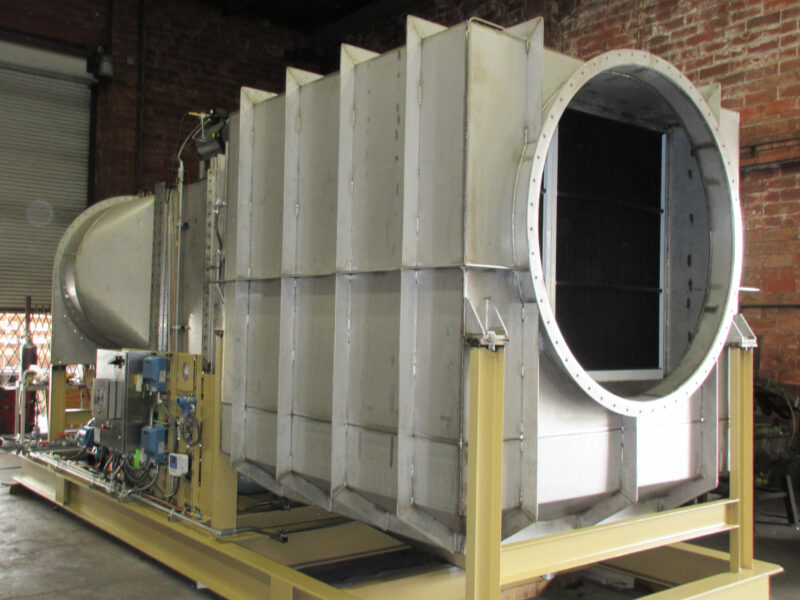
Last November I made a blog post describing the use of a wet electrostatic precipitator (WESP) for meeting metals emisssions.  This topic will be discussed in greater detail in an Envitech paper being presented at the 2010 A&WMA 103rd annual conference in Calgary, Canada.   wet electrostatic precipitator

The metals of concern can include mercury, arsenic, lead, cadmium, nickel and others, depending on the process.  A control strategy using a wet electrostatic precipitator (WESP) in conjunction with sub-cooling was used on a secondary lead smelter to meet more stringent emission standards.  This approach achieved > 98% removal of arsenic and > 92% removal of lead and other condensed metals downstream of a bag-house.  This substantially reduced the plant's cancer risk index and helped to meet reduced fence line lead emission limits.   

The table below provides a summary of other processes facing similar challenges including the additional removal efficiencies that can be required downstream of existing air pollution controls.  Most of the processes are from combustion sources and use a range of air pollution controls including bag-houses, packed bed absorbers, and Venturi scrubbers.  In some cases a combination of controls are used. Despite existing controls, very low concentrations of heavy metals can be emitted.  In the case of bag-houses for instance, the operating temperature may be in a range that some of the metals are in a gas phase.  In such case they will not be collected by particulate control devices. In other cases, the concentrations of submicron, condensed phase heavy metals may exceed the removal capability of controls like packed bed absorbers or Venturi scrubbers.

Process Upstream Controls Compounds Requiring Polishing  Add-On Removal Efficiency* 
Secondary Lead Smelters

Bag-houses

Packed Bed Absorbers 

 Lead (Pb)

Arsenic (As)

 92% - 98%

Primary Lead Smelters

Bag-houses

 Arsenic (As)  > 85%
Hazardous Waste Incinerators

Venturi Scrubbers

Packed Bed Absorbers

 Lead (Pd)

Cadmium (Cd)

Mercury (Hg)

 80% - 90%
Refinery Sludge Incinerators

Venturi Scrubbers

Packed Bed Absorbers

 Cadmium (Cd)  98%-99%
Geothermal Plants Packed Bed Absorbers

 Arsenic (As)

Mercury (Hg)

 > 90%

*Refers to additional removal efficiency after the upstream controls. 

The performances achieved on a secondary lead smelter using a WESP, suggest the approach can be used on these other processes to remove residual concentrations of condensed metals.  In the case of mercury, the ability to remove it with a WESP depends on whether it is in a condensed form. This requires reliable speciation data to make that determination.  More specifically, the mercury must be in a particulate or oxidized form for it to be removed by a WESP.

Please click on the below icon to download a white paper on this topic from the 2010 A&WMA's 103 Annual Converence in Calgary, Canada: "Wet Electrostatic Precipitator (WESP) Control for Meeting Metals Emission Standards".

WESP HEX Tubes

Wet Electrostatic Precipitator Control for Meeting Metals Emissions

  | Share on Twitter Twitter | Submit to Digg digg it |  Add to delicious  delicious |  Submit to StumbleUpon StumbleUpon |  Share on LinkedIn LinkedIn | Submit to Reddit reddit 

There are several industrial processes that face the challenge of meeting increasingly aggressive metals emission standards.  In many cases these standards exceed the capability of existing air pollution control equipment which can include bag-houses and packed bed absorbers. Some of these processes include:Refinery

  • Secondary lead smelters
  • Lead refining
  • Refinery sludge incinerators
  • Geothermal energy plants

Some of the metals of concern can include mercury, arsenic, lead, cadmium, nickel and others, depending on the process.  To achieve more stringent metals emission standards, three features should be designed into the air pollution control system. 

  • Removal of the bulk particulate load
  • Sub-cooling the gas
  • Wet Electrostatic Precipitator (WESP) for polishing

Geothermal EnergyRemoval of the bulk particulate load - Removal of the bulk particulate load may be required if there is a high particulate concentration from the upstream process.  This will be the case for secondary lead smelters, lead refining, and refinery sludge incinerators.   Geothermal energy plants will not have this requirement.  A bag-house will be used for secondary lead smelters and lead refining.  A wet Venturi scrubber system can be used for refinery sludge incinerators   Removal of the bulk particulate minimizes space-charge effects inside the WESP. Space-charge effects occur when particles interact and repel each other. This reduces WESP performance because it interferes with the migration of charged particle to the tube wall for collection.

Sub-cooling the gas - Some of the volatile metals may be in the vapor phase when they pass through a bag-house at higher temperature.  In this case they will pass right through the bag-house and will not be collected.   Sub-cooling the gas is done after the bag-house and uses a condenser/absorber to cool the gas below the saturation temperature.  Sub-cooling is beneficial because it condenses as much of the volatile metals as possible so they can later be removed as particulate.  In the case where a Venturi is used to remove bulk particulate, like for a refinery sludge incinerator, it has the added benefit of condensing water onto the particulate and condensed metals.  This increases their diameter making them easier to remove in a Venturi scrubber.  Sub-cooling also reduces the gas volume, which helps to reduce the size and cost of a downstream WESP.

Wet Electrostatic Precipitator (WESP) for polishing - A wet electrostatic precipitator is used as a final particulate polishing stage.  The performance is relatively independent of the particle size so it is highly effective at sub-micron particulate control.  In some cases, a condenser/absorber (C/A) for sub-cooling can be integrated into the conditioning section of an upflow WESP.  This was successfully done at a secondary lead smelter downstream of bag-house.  The C/A was also used to neutralize SO2 in the gas stream. The integrated C/A and WESP achieved > 98% removal of arsenic and > 92% removal of lead and other condensed metals after the bag-house.  This substantially reduced the plants cancer risk index and helped to meet more stringent fence line lead emission standards. 

To download a free white paper on wet electrostatic precipitator for a secondary lead smelter, click the icon below.

wet electrostatic precipitator

To view a free wet electrostatic precipitator video, click on the icon below. 

wet electrostatic precipitator

Photo Credits

Geothermal by Louis Falcon

Refinery by Szeke

CFD in Air Pollution Control Systems

  | Share on Twitter Twitter | Submit to Digg digg it |  Add to delicious  delicious |  Submit to StumbleUpon StumbleUpon |  Share on LinkedIn LinkedIn | Submit to Reddit reddit 

By Mike Simon
Director of Simulation Products, Digital Dimensions

Understanding how simple design changes affect the airflow inside of Envitech's products is critical in designing efficient industrial gas cleaning systems.  Engineers who design this equipment need to analyze and understand the behavior of the components if they want to improve performance.  Computational Fluid Dynamics (CFD) is a good tool for studying the effects of different design changes on these systems.  CFD provides a way to save time and money in obtaining the necessary information, and assists engineers in designing better quality air pollution control systems.    The use of CFD makes it possible to minimize the use of physical prototypes and find serious flaws much earlier in the design process. 

SolidWorks is the 3D CAD system used by Envitech to design their industrial gas cleaning systems.  SolidWorks has a number of complementary features to its mechanical CAD system including CFD capabilities that are fully integrated within the main CAD interface.  SolidWorks Flow Simulation is the name of the CFD program inside of SolidWorks that allows engineers to take their 3D CAD models and perform virtual prototyping on their designs without having to fabricate any parts.  To perform a simulation, the following steps are needed:

  • 1. Create solid model in the SolidWorks CAD system
  • 2. Specify the working fluid ( air was used in this case)
  • 3. Specify the flow rate at the duct inlet
  • 4. Specify the outlet opening of the duct
  • 5. Specify the pressure drop or resistance properties of the filter material (properties taken from filter manufacturer specifications)
  • 6. Run the simulation inside of the SolidWorks interface

Flow Simulation


Envitech's products were particularly challenging since Envitech's products utilized very thin fins and packing materials within a large ducting area.  Thin fins are used to direct the airflow and also to collect water from entering the system.  SolidWorks Flow Simulation was able to capture the geometry of these thin fins and create a corresponding CFD model for the simulations.  Packing material is used to help distribute airflow and trap particulates from being released into the environment.  The porous media feature inside of SolidWorks Flow Simulation was used to simulate the packing material and create the additional resistance to the airflow.  After performing the simulations, the Envitech engineers had the ability see the effectiveness of the scrubber fins in directing the airflow and to understand the pressure drops caused by the packing material.  The simulations helped the Envitech engineers validate their designs and gave them additional insight into how to improve future product performance.

For additional information on SolidWorks CAD or SolidWorks Flow Simulation software, go to http://www.ddicad.com/ or contact Mike Simon, Director of Simulation Products, at msimon@ddicad.com.

Acid Gas Dewpoint

  | Share on Twitter Twitter | Submit to Digg digg it |  Add to delicious  delicious |  Submit to StumbleUpon StumbleUpon |  Share on LinkedIn LinkedIn | Submit to Reddit reddit 

acid gas dewpointAcid gases can be found in the exhaust of a large number of combustion processes.  As a gas, the acid compounds usually are not particularly corrosive and are relatively easy to remove.  However, when the temperature of the gas drops below the acid gas dewpoint, an acid mist can form.  The acid mist can turn into a fine aerosol or it can condense on a cold surface.  Acid mist poses a number of design problems, due to the small size of the mist particles and the corrosivity of the liquid form of the acid.

Aerosol Formation

Aerosol formation occurs when the bulk temperature of the gas drops below the acid dewpoint of the gas.  Much like the formation of fog, the acid gas condenses into tiny liquid droplets.  The size of these droplets can vary widely depending on the acid, the amount of condensation nuclei present in the gas, and degree of supersaturation.

The most common problem that occurs with acid aerosol formation is the inability to capture the aerosol.  Many acid gas exhaust treatment systems utilize a packed bed scrubber to remove the acid.  Packed bed scrubbers are extremely efficient at removing acid in the gas, but unfortunately are ineffective at removing acid aerosol.

The solution to removing acidic aerosol mist is to use a high efficiency entrainment separator or Venturi scrubber, which can effectively capture particles to 1-micron or 0.5-micron, respectively.  If the acidic aerosol mist is primarily sub-micron in nature, a wet electrostatic precipitator also provides a useful solution.

Wall Condensation

Wall condensation occurs when a cold surface is in contact with a hot gas.  If the wall is cooler than the acid dewpoint, acid can condense onto the surface of the wall.  There are several dangers with wall condensation.

First, the material selection for an acid is dependent on its form.  Many acids are not corrosive as a gas, but are very corrosive as acids.  Engineers selecting materials under the assumption that the acid remains a gas often choose materials that are not compatible with the acid in its liquid form.

Second, when condensed, the acid is much more concentrated than it is in the bulk medium.  Instead of selecting a material for a gas containing 10 ppm of SO3 gas, the engineer now has to worry about a nearly pure sulfuric acid droplet.

Finally, the acid can condense in non-ideal locations, leading to pooling and further corrosion concerns.

The solution to preventing the effects of wall condensation is to insulate walls to prevent cold surfaces and select materials for the concentrated, liquid form of the acid in locations where wall condensation is unavoidable.

Acid Dew Point

All gases have a dew point that is dependent on the temperature, pressure, and concentration of the acid in the gas.  This article provides acid gas dewpoint equations for a number of acids.  Below are the formulae for a few of the more common acids in exhaust gases.

Tdp = Dewpoint Temperature, K

Pw = Partial Pressure of water, mmHg

Pa = Partial Pressure of acid, mmHg

Hydrochloric acid (HCl)

1000/Tdp = 3.7368 - 0.1591 * ln (Pw) - 0.0326 ln (Pa) + 0.00269 * ln (Pa) * ln (Pw)

Sulfur Dioxide (SO2)

1000/Tdp = 3.9526 - 0.1863 * ln (Pw) + 0.000867 ln (Pa) - 0.000913 * ln (Pa) * ln (Pw)

Sulfuric Acid (H2SO4)

1000/Tdp = 2.276 - 0.0294 * ln (Pw) - 0.0858 ln (Pa) + 0.0062 * ln (Pa) * ln (Pw)

Photo Credit: tinyfroglet

Instrumentation

  | Share on Twitter Twitter | Submit to Digg digg it |  Add to delicious  delicious |  Submit to StumbleUpon StumbleUpon |  Share on LinkedIn LinkedIn | Submit to Reddit reddit 

air pollution control instrumentationOne of the most difficult value engineering challenges I encounter is the selection of instrumentation.  Instrumentation within air pollution control systems may be subject to high salinity, high halide concentrations, pH swings, extreme temperatures, extreme ambient conditions, intrinsically safe environments, and abrasive particulate, just to name a few.  Selecting the proper instrumentation for each environment is a chore and can dramatically effect the cost.  It is a topic that both end-users and integrators should attempt to resolve before a system is built.

Extreme temperatures

Most know of the obvious differences between outside environments as opposed to inside environments.  Rain, snow, and sun all batter instruments outside; equipment inside rarely see any of the three.  Extreme heat though is not the exclusive domain of outside environments - I am currently working on a project where inside temperatures can reach 140F.  For that project, I have moved all of the temperature sensitive transmitters inside an air conditioned control cabinet to meet the temperature requirements of the analyzer.  When dealing with extreme temperatures, it is best to find ways to reduce the effect.  For extreme cold environments, use insulation or heat tracing.  For the extreme heat, look at moving sensitive electrical equipment into a temperature controlled environment.  Remember, plan for the extremes!

Be a copycat

A lot of the projects that I see are retrofits - the addition of new air pollution control equipment on existing processes or equipment.  In these cases, it is usually best to select instrumentation that is already working well within the plant.  First, copying instrumentation removes most doubts of instrument failures.  Second, operators have a familiarity with the instrumentation, and are more apt to use the instrumentation properly.  Finally, copying instrumentation reduces the number of spares that a plant needs to keep available, thus reducing the net cost of the instrument.  Whether you are buying the equipment for a customer, or buying equipment with prepackaged instrumentation, always find out what instrumentation is already working! 

Preventive Maintenance

Even after selecting the right equipment, there is still the need to properly maintain the equipment.  Acid gas scrubbers almost always require a pH probe for dosing basic reagents; those pH probes require regular calibration and often have lifetimes of six months.  A probe off by 1.5 pH units can cause a drop in acid gas removal efficiency from 99% to 75% - a significant problem if your stack tester is visiting! Conductivity sensors and hardness analyzer and ion selective electrodes also require regular maintenance.

For instruments that do require calibration, it is important to use bypasses to allow for calibration during operation.  A bypass loop with an instrument hold function allows an operator to carefully calibrate the instrument while the system continues to operate in a safe fashion.

Recommendations

Above all else, work with the end-user to identify instrumentation requirements.  A customer running a 24/7 operation has dramatically different requirements for instrumentation than one that is on a single shift operation or batch process.  Operators should be thought of as well.  Are the instruments accessible?  Can operators view indicators?

Remember, selecting the right instrumentation minimizes downtime; downtime that may cost you ten times the price of the instrument.

Venturi Scrubber Particle Size Distribution Test (PSD) Method

  | Share on Twitter Twitter | Submit to Digg digg it |  Add to delicious  delicious |  Submit to StumbleUpon StumbleUpon |  Share on LinkedIn LinkedIn | Submit to Reddit reddit 

venturi scrubber particlesEnvitech is often asked to make recommendations for particulate removal on a wide range of industrial applications.  This might entail deciding if a Venturi scrubber can do the job or if a wet electrostatic precipitator (WESP) is required.  Envitech uses proprietary modeling that accurately predicts Venturi performance under various conditions of pressure drop and sub-cooling.  Because Venturi performance is highly dependent on particulate size for particles less than 1 micron diameter, an essential piece of data for making a performance guarantee is the particle size distribution (PSD) for the particles in the inlet gas.

cascade impactorThere are several test methods for determining the particle size distribution, however the test method must determine the aerodynamic particle size to adequately precdict the Venturi performance.  The most common method for determining the aerodynamic particle size is to use a cascade impactor.  This can be a challenging test because the inlet gas stream may be at high temperature and contain a high particulate loading and moisture content.  It is important to select a testing company that has experience with this type of environment.  A company that has this experience is Air Source Technologies located in Kansas City, KS.  Envitech has worked with Air Source to test biomass gasification syngas and lime kiln flue gas.  Below are some references from the California Air Resource Board that describe acceptable test methods for this purpose.

A method that some companies use to to determine the PSD is to collect particles on a filter and analyze the dust with a particle size analyzer.  This test method will give the physical particle size.  However it can give an inaccurate estimate of the aerodynamic particle size.

The problems commonly associated with this method are outlined below:

  • You may not get a representative sample. Different size particles end up in different layers on the filter. Agglomerates of particles can come apart. Individual particles can agglomerate and show up as one particle.
  • This is a measure of the physical size and not the aerodynamic size. Venturi scrubbers primarily collect particles according to their aerodynamic size through inertial mechanisms. The aerodynamic size is a function of the density of the particle and the size of the particle. The greater the density, the greater the aerodynamic size. In some cases, particles may not be solid particles of inorganic material, but may be hollow glassy spheres, which will make them act more like soap bubbles rather than hard balls. Some combustion processes at extremely high temperatures can lead to hollow spheres.
  • The size of the particle affects the aerodynamic size because, the smaller the particle, the easier it is to slip between gas molecules. As the particle size approaches the mean free path of the gas molecules this becomes a significant component of the aerodynamic size.
  • To use data from a particle size analyzer, it is necessary to generate a log normal PSD curve of the physical size. This curve then needs to be corrected to provide an aerodynamic PSD curve. However, this requires making two assumptions: 1) particle density, and 2) particle shape (usually assumed to be a solid spherical shape). These assumptions may or not be valid and can lead to inaccurate Venturi performance predictions.

Before settling on a design path for particulate removal, Envitech recommends testing the process to generate good particle size distribution data.  This will help ensure meeting the performance requirements in the most economical way possible.

photo credit: azredheadedbrat

Wet Electrostatic Precipitator for Pellet Mills

  | Share on Twitter Twitter | Submit to Digg digg it |  Add to delicious  delicious |  Submit to StumbleUpon StumbleUpon |  Share on LinkedIn LinkedIn | Submit to Reddit reddit 

I recently received a call from a small pellet mill operator inquiring about a visible stack emission problem at his plant.  The pellet mill is operating a rotary dryer and is small enough that they are not required to have pollution controls on the process.   However, they have started to receive complaints from neighbors about a visible blue haze being emitted from their stack.

The blue haze is a result of condensable organic compounds in the gas stream which condense in the duct and form very small, submicron particulate. This particulate is an aerosol mist. When the mist in the exhaust passes out the top of the stack, the light reflects through the mist and a blue haze appears.

This is a particulate control problem.  In general, there are three options to consider for particulate control.

  1. Bag-house
  2. Venturi scrubberWet Electrostatic Precipitator
  3. Electrostatic precipitator

A bag-house is a fabric filter that is generally used for higher temperature applications.  It would not be a suitable solution for this process because of the moisture content and the temperature of the exhaust gas.  The bags would plug up and have maintenance issues. The other two options to consider are discussed below:

Venturi Scrubber - A Venturi scrubber is a lower cost option, however, it also is not suitable for this application. The efficiency of a Venturi is dependent upon the particle size distribution (PSD) and drops off rapidly for particles less than 1 micron. Because this gas stream has a large concentration of sub-micron particulate (as evidenced by the blue haze), a Venturi will do very little to resolve the problem.

Wet Electrostatic Precipitator (WESP) - A Wet Electrostatic Precipitator is the most suitable technology for this problem.  A WESP has a higher capital cost than a Venturi system, but the removal efficiency is independent of the particle size.  It is most often used in situations where there is a high concentration of sub-micron particulates and the particulate are beyond the removal capability of a Venturi.

Although a WESP will resolve the blue haze caused by the aerosol mist, it will not do anything to remove gas phase volatile organic compounds (VOC).  Larger pellet mill operators that have permit limits for VOCs will likely need a WESP for particulate control, followed by a thermal oxidizer for VOC control.

Wet Electrostatic Precipitators - What's Inside

  | Share on Twitter Twitter | Submit to Digg digg it |  Add to delicious  delicious |  Submit to StumbleUpon StumbleUpon |  Share on LinkedIn LinkedIn | Submit to Reddit reddit 

Wet electrostatic precipitators (WESP) are the preferred equipment for the removal of sub-micron particulate.  Sub-micron particulate control is a subset of particulate control, typically used for TSCA (Toxic Substances Control Act) particulate or where downstream equipment might be damaged by sub-micron particulate.

What is inside this efficient particulate removal equipment?  We have put together a short video that brings you inside the WESP and provides a high level overview of the equipment required for an electrostatic precipitator.

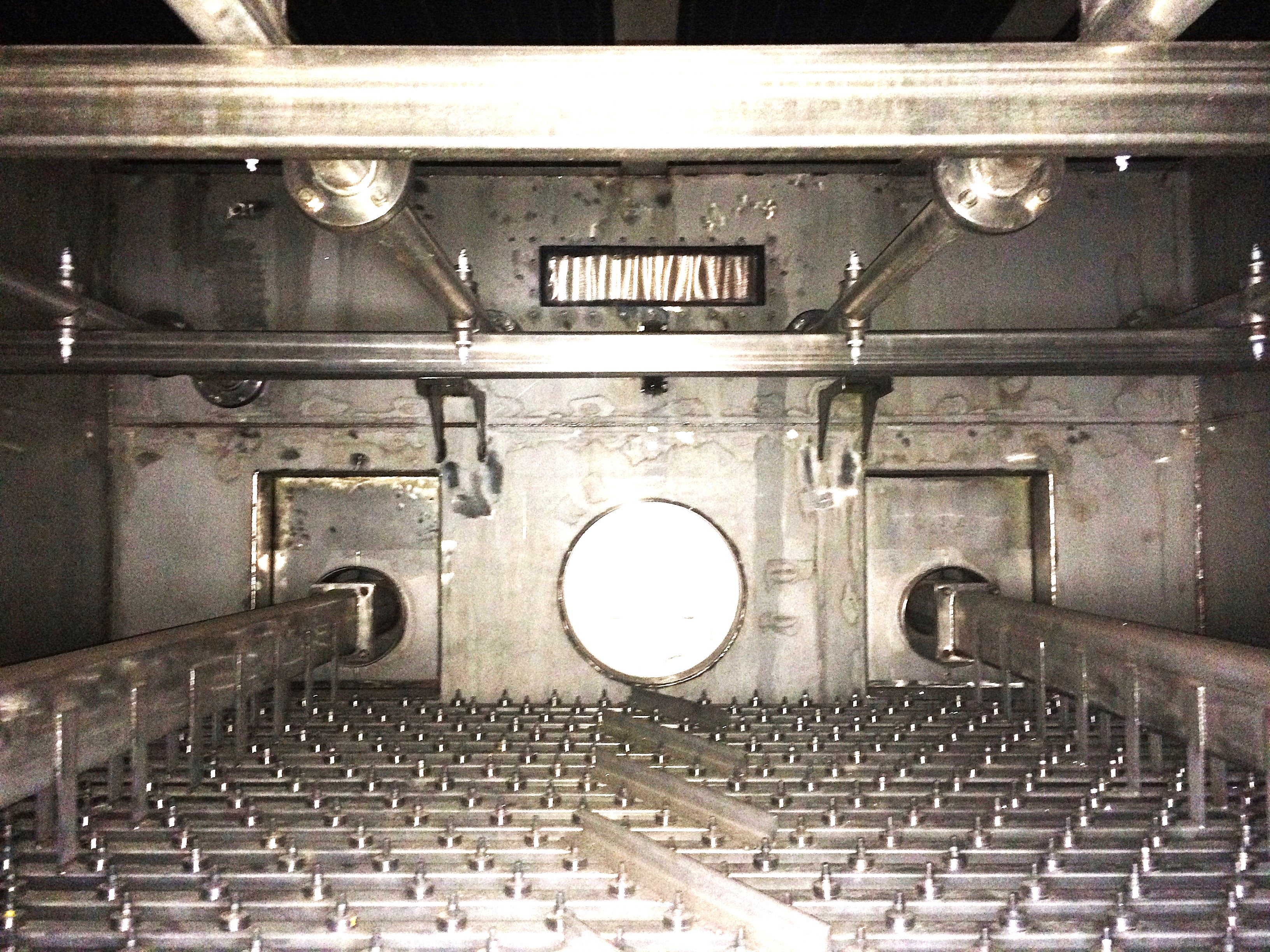
High voltage is brought into the insulator compartments, through the high voltage grid, and on to the electrodes.  The collector assemblies are grounded, leading to a high voltage differential between the electrodes and the collector.  Emitter discs on the electrodes promote electron migration from the electrode to the collector plate; particles are charged by colliding with the electrons.  The negative charge on the particle in turn attracts the particle to the collector.

Wet electrostatic precipitators are very efficient at the removal of sub-micron particulate, with single pass systems able to remove over 90% of sub-micron particulate.  We recommend electrostatic precipitators for most applications where efficient removal of sub-micron particulate is essential.

Wet electrostatic precipitator technology

  | Share on Twitter Twitter | Submit to Digg digg it |  Add to delicious  delicious |  Submit to StumbleUpon StumbleUpon |  Share on LinkedIn LinkedIn | Submit to Reddit reddit 

Ron PattersonIn 1824, the German mathematician M. Hohlfeld described the removal of particles from gas streams by electrical forces.  However, it was almost a century later when Dr. Frederick G. Cottrell at the University of California, Berkeley commercialized the technology by building the first wet electrostatic precipitator. 

A wet electrostatic precipitator uses electrical forces to move particles entrained in a gas stream onto collection surfaces.  Electrodes in the wet electrostatic precipitator are held at high voltage which creates a corona discharge.  Particles receive an electrical charge as they pass through the corona.  The charged particles then follow electric field lines from the charging electrodes to collection surfaces, where they are removed from the gas stream.  


WESP Collection Section

Dr. Cottrell applied wet electrostatic precipitator technology to the removal of sulfuric acid mist and lead oxide dust emitted from various acid-making and smelting activities.  At the time, vineyards in Northern California were being adversely affected by the lead emissions.  Dr. Cottrell's innovative wet electrostatic precipitator solved their problem.

Fast forward to the 2000's.  Envitech brought the control of lead and sulfur dioxide to a new level by installing our most advanced wet electrostatic precipitator technology on a secondary lead smelting facility in Southern California.  The resulting wet electrostatic precipitator system which removes both sulfur dioxide and lead particles is said to set a new standard in air emission control at lead smelting facilities worldwide.

With over thirty years in the industry, we wanted to start sharing the knowledge and expertise that we have gained from cleaning gas streams of unwanted contaminants.  Look for future postings that examine various aspects of state-of-the-art air pollution control technologies.


All Posts