


Quenchers are used in air pollution control equipment to rapidly cool a high temperature gas stream. Rapid cooling prevents gas phase reactions that may occur at intermediate temperatures, such as dioxin and furan formation. Rapid cooling also relaxes the material requirements of downstream equipment, allowing the use of materials such as FRP, CPVC, and duplex steels.
In the video above, we take a look at a rectangular quencher. We have used the rectangular quencher for regenerative thermal oxidizers. A rectangular quencher provides sufficient quenching for relatively low temperature gas streams (200F to 600F). Water is sprayed directly on to the gas, away from the upstream process. Water drains from the quencher into the basin for recirculation.
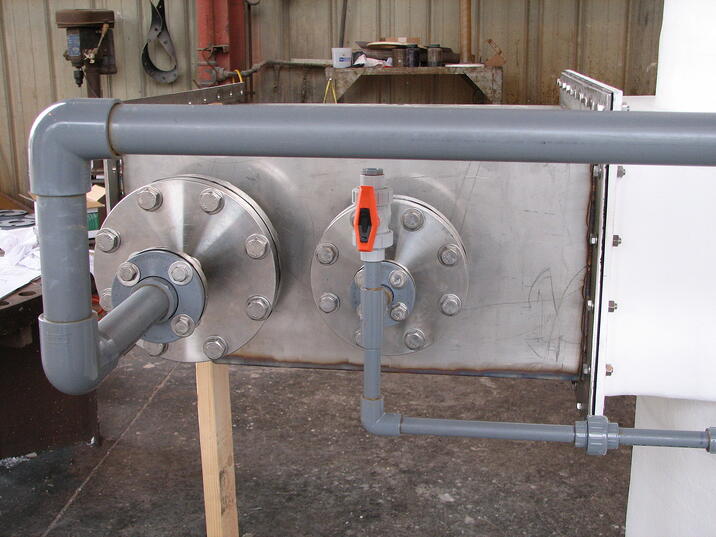 In the picture to the right, the spray headers are installed using a double flange approach. The two flange approach improves the accessibility of the nozzles in the quencher, which can be susceptible to plugging in some applications. Water is connected to the first (header) flange. The second flange connects to the quencher. The spray header can then be removed like a lance.
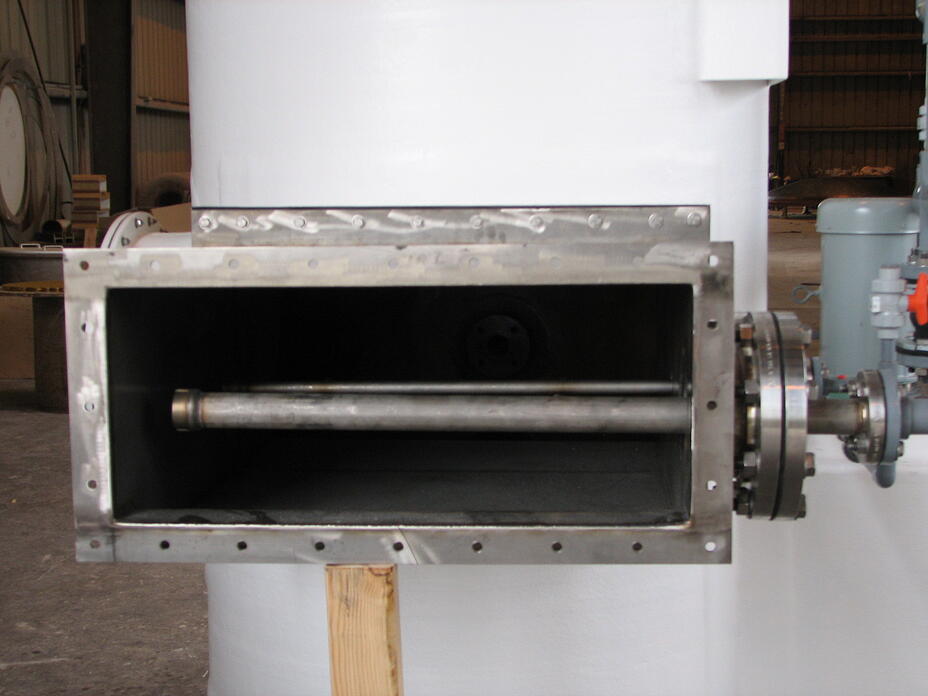 The picture to the left shows an example of a rectangular quencher. A rectangular quencher in low flow, low temperature quench applications are typically more cost-effective than round quenchers, especially if they are attaching to rectangular or horizontal ducts.
Download a 3D video of the spray lances using the link below.
